

A dishwasher is a warm, wet, dark box that handles food residue several times a week. Left to itself it will smell. The question is only which of four things is causing it, and they are easy to work through in order.
Do them in this order. You will probably not get past the second.
1. The filter
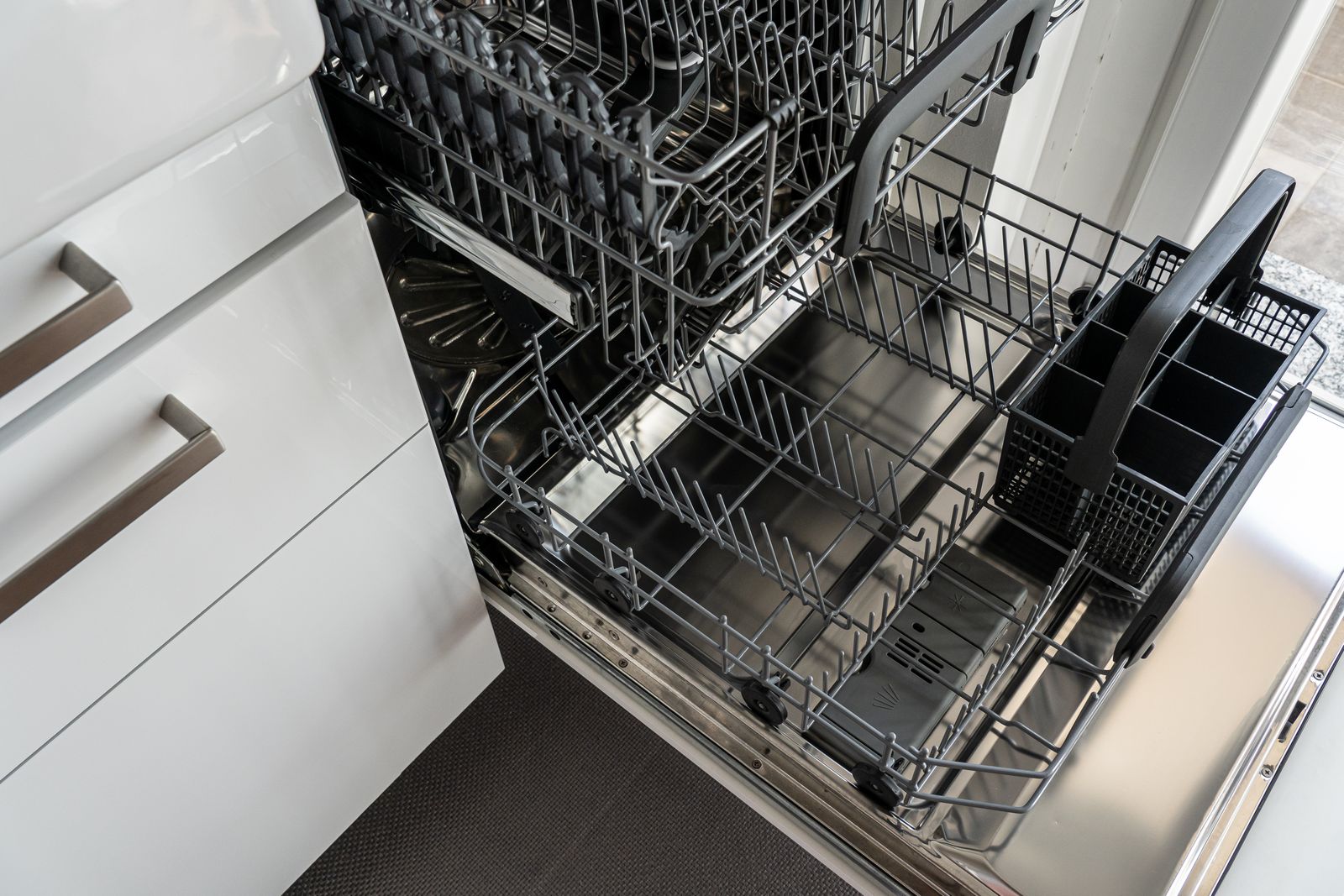
Nearly every dishwasher made in the last fifteen years has a removable filter in the floor of the tub, under the lower spray arm. Older American models had a hard food disposer instead and did not need cleaning; almost nothing sold now does.
Twist the cylindrical part anticlockwise and lift it out. Underneath is a flat mesh screen that also lifts out on most models.
What comes out of there after six months is the answer to most smell complaints. Rinse both parts under a hot tap, use a soft brush on the mesh, and put them back. Do it monthly.
If you have owned the machine for years and have never done this, that is not unusual — it is the single most-missed piece of appliance maintenance there is.
2. The spray arms and the seal
Take the lower spray arm off — most unclip or unscrew by hand — and hold it up to the light. The small jets block with seeds, grit and label paper. A cocktail stick clears them.
Then run a cloth around the rubber door seal, particularly the bottom corners where water collects and sits. And open the door fully and look at the lip of the tub below the seal. There is usually a shallow channel there that never drains and never gets touched.
3. The drain hose loop
This is the one that gets missed, and it is the cause when the smell is specifically of drains rather than old food.
The drain hose from the dishwasher must rise to a high point — normally up under the worktop — before it runs down to the waste connection. That loop is what stops dirty water from the sink siphoning back down the hose toward the machine.
If the hose runs flat from the machine to the waste, or the installer never fixed the high loop to the underside of the counter, you get sink water sitting in the hose. That smells exactly like a drain, because it is one.
Open the cupboard under the sink and look. The fix is a cable tie and five minutes.
While you are there, check whether the hose connects to an air gap fitting on the worktop or to the disposer inlet. If it goes to a disposer, make sure the knockout plug was actually removed when it was installed — a partially removed plug restricts the drain and leaves standing water in the tub.
4. Standing water in the sump
Look at the floor of the tub an hour after a cycle finishes. There should be a film of moisture, not a pool.
Water that does not clear means a drain restriction: the filter (see 1), the drain pump impeller jammed with something small and hard, or the hose. Standing water always eventually smells.
If the machine also leaves dishes wet and gritty, the drain is the likely culprit rather than the wash.
The maintenance wash
Once all four are clean, run an empty cycle on the hottest setting with either a proprietary dishwasher cleaner or a cup of white vinegar in a bowl on the top rack. This is a finishing step, not a fix — running it while the filter is still full accomplishes nothing, which is why it is at the end of this list rather than the start.
Once a month is plenty.
Two habits that make it worse
Rinsing everything spotless before loading. Modern detergents contain enzymes that need food residue to work against. Scrape, do not rinse.
Closing the door immediately after unloading. Leave it ajar for an hour. A sealed damp box grows things; a ventilated one does not.
When it is not the smell that is the problem
If you have a smell and the dishes are coming out dirty, or there is water on the kitchen floor, that is a different conversation — a failed drain pump, a leaking door seal, or a heating element that is not getting the water hot enough to clean properly.
Dishwasher repair is one of our more common calls and most of it finishes in one visit, because the parts that fail — drain pumps, door seals, heating elements — ride on the van. Call (617) 685-8530, and if you have already done the four steps above, say so. It saves the technician twenty minutes and you the cost of them.


